
China Provides a Good Example As To Why Regulation Might Do More Harm Than Good
China's use of AI regulation to enforce political conformity provides valuable lessons for the West

CONTACT: zzzz707@live.com.au
This text was produced with AI support. I supplied the title and key points. I then revised it through further instructions. The ideas are mine; AI was used as an assistant, not an author.
Overview
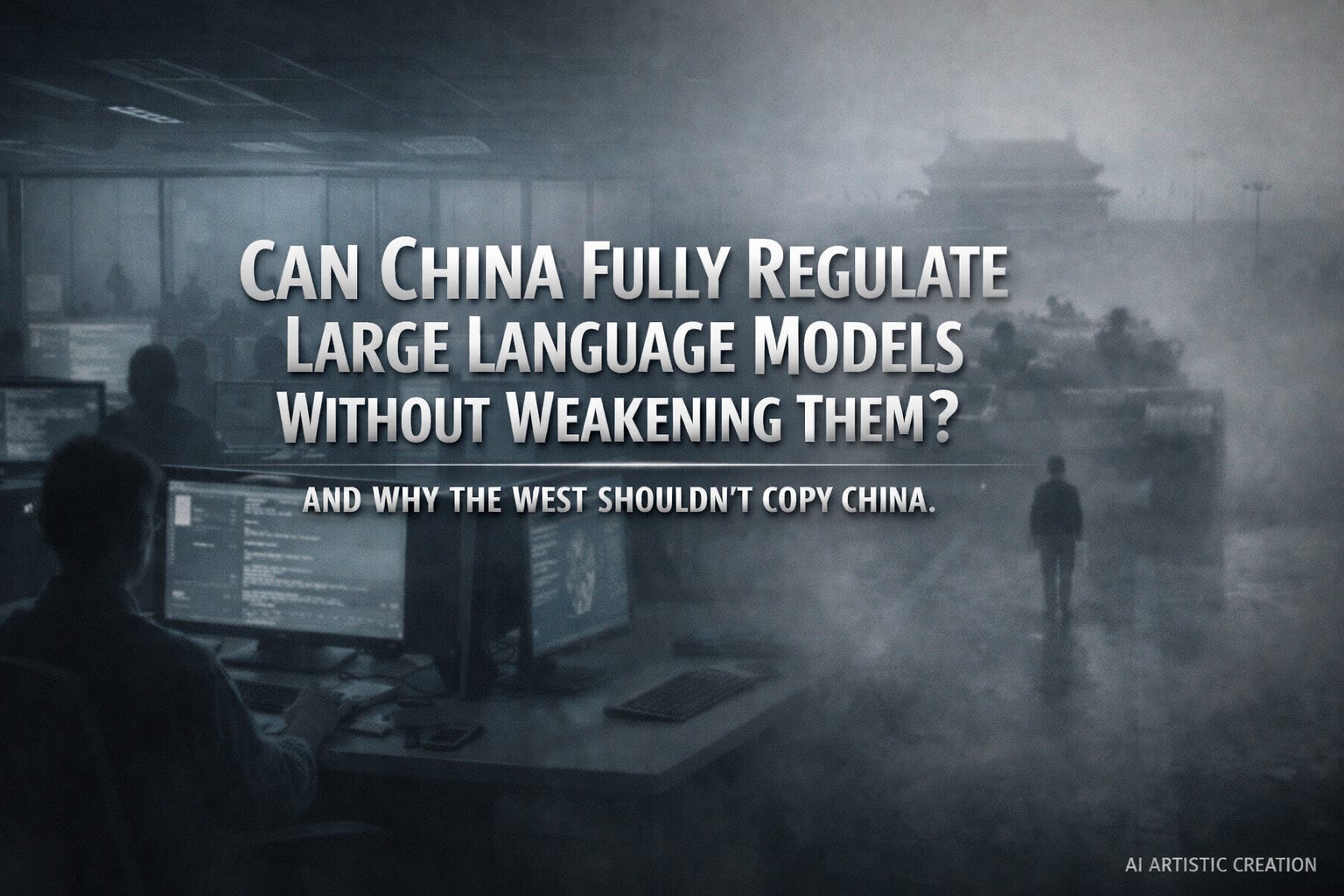
China can regulate the public deployment of large language models, and it is already doing so through a dense and expanding framework of rules. Its existing regime gives the state leverage over providers, platform access, labelling, and the visible behaviour of public-facing systems. In March 2025, Chinese regulators formally adopted rules on labelling AI-generated synthetic content, adding another layer to an already active governance structure.
But that does not settle the harder question. Regulating who may deploy a model, under what conditions, and with what visible warnings is one thing. Ensuring that a powerful general-purpose model remains broadly useful while never producing politically disapproved criticism, inference, or comparison is something else. Large language models are not ordinary publishing systems. They generate novel responses at inference time, recombine what they have learned in flexible ways, and often reach similar conclusions through multiple paths.
That is why control has to be layered: training choices, fine-tuning, system prompts, output filters, monitoring, product design, and legal pressure on providers. Some of those measures can improve safety and reliability. But the broader and more political the prohibited category becomes, the greater the risk that the model turns evasive, brittle, and less useful. China’s problem is therefore not whether it can govern AI products. It plainly can. The problem is whether it can impose exhaustive political discipline on increasingly capable general-purpose models without paying a serious price in openness, candour, and analytic usefulness.
Glossary of terms
• large language model: An AI system trained on very large text datasets to generate and analyse language.
• inference: The stage when a trained model answers a prompt.
• alignment: Methods used to steer a model’s behaviour toward chosen rules or goals.
• over-refusal: When a model declines safe or legitimate requests because its restrictions are too broad.
• fine-tuning: Additional training after the main training phase to change behaviour.
• open-weight model: A model whose trained parameters are released for others to run or modify.
• compliance burden: The legal, technical, and administrative cost of meeting regulatory requirements.
• political speech control: Restrictions aimed at preventing criticism or challenge to the ruling political order.
Key points
China can regulate deployment more easily than model cognition: It is much easier to control market access, filings, labels, and provider obligations than to ensure a model will never generate an unwanted line of reasoning.
Political supervision is part of the point, not an accidental side effect: China’s AI rules are not limited to fraud, safety, or consumer transparency but sit within a broader model of information control and social management.
General-purpose models are harder to discipline than traditional media: A newspaper article can be reviewed before publication, whereas a chatbot produces fresh outputs in real time.
Not all regulation is bad for performance: Some constraints improve trustworthiness, reduce abuse, and make systems more dependable, and a serious argument should concede that at the outset.
The harder problem is broad political steering: The trouble starts when the forbidden category is not a narrow class of harmful acts but a broad field of politically disapproved judgments, analogies, and conclusions.
That raises the risk of over-refusal: A model trained to avoid crossing vague political lines is likely to become more generic, more sanitised, and less analytically useful.
China therefore faces a real trade-off: It wants frontier capability and tight political control, and those goals are not always incompatible but do not naturally reinforce one another either.
Wider model diffusion makes total control even harder: As methods spread, models proliferate, and open-weight ecosystems grow, control over the entire technical field becomes harder than control over licensed public deployment.
The real comparison is not regulation versus anarchy: It is regulation aimed at concrete harms versus regulation aimed at viewpoint management.
The strongest conclusion is limited, but important: China can regulate AI products very heavily, but it remains doubtful whether any state can keep highly capable general-purpose language models both broadly useful and exhaustively politically compliant at the same time.
Conclusion
There is a broader lesson here, and it does not stop at China. In Western debates, calls for “better AI regulation” are often presented as obviously prudent, humane, and democratic. Sometimes they are. But China shows that regulation is not a neutral tool. It can also be used to enforce ideological conformity, narrow the space of acceptable thought, and turn powerful models into instruments of state direction. The Chinese system makes that dynamic unusually visible because the political mandate is explicit.
That should make Western audiences more cautious about what exactly they are demanding when they ask for tighter AI controls. Governments, corporations, universities, and cultural institutions all have incentives to convert “safety,” “responsibility,” and “governance” into systems for filtering dissent and protecting their own authority. The rhetoric will be softer than Beijing’s, and the legal environment will be different, but the temptation is not unique to China. If powerful institutions are allowed to decide which model outputs are acceptable in the name of public responsibility, AI governance can become a machinery of managed consensus rather than a guardrail against clear harms.
That is why some degree of loss, messiness, or imperfect controllability may actually be desirable. A less perfectly domesticated AI system may be less convenient for governments, firms, and prestige institutions that want seamless alignment with their priorities. But that same imperfection can function as a defence against unified state, corporate, academic, or cultural control. The choice is not simply between wise regulation and reckless freedom. It may also be a choice between controlled intelligence that reliably serves dominant institutions and imperfect intelligence that leaves more room for dissent, unpredictability, and independent thought.
OFFICIAL SOURCES AND RECORDS
(Paste sources and instructions below into an AI to locate the sources.)
Instructions to AI: Locate the cited official history, archival series, or institutional record using the citation text provided; supply current links and identify the controlling authority.
• Cyberspace Administration of China et al. (2025), Measures for Labeling of AI-Generated Synthetic Content.
• Stanford HAI (2025), AI Index Report 2025.
• Carnegie Endowment for International Peace (2025), China’s AI Policy at the Crossroads.
• Brookings Institution (2025), How Will AI Influence U.S.-China Relations in the Next 5 Years?
• CSIS (2025), The Architecture of AI Leadership: Enforcement, Innovation, and Global Trust.
• ITU (2025), The Annual AI Governance Report 2025.
• ANSI (2025), China Announces Action Plan for Global AI Governance.
Further Reading
• Cyberspace Administration of China et al. (2025) Measures for Labeling of AI-Generated Synthetic Content.
• Stanford HAI (2025) AI Index Report 2025.
• Carnegie Endowment for International Peace (2025) China’s AI Policy at the Crossroads.
• Brookings Institution (2025) How Will AI Influence U.S.-China Relations in the Next 5 Years?
• CSIS (2025) The Architecture of AI Leadership: Enforcement, Innovation, and Global Trust.
• ITU (2025) The Annual AI Governance Report 2025.
• ANSI (2025) China Announces Action Plan for Global AI Governance.